
Stopping Distances Theory Test 2026 – Full Formula + Real Examples Explained
Understanding stopping distances theory test 2026 is essential if you want to pass your UK driving theory test confidently. This topic is one of the most important safety concepts because it directly affects how quickly you can stop your vehicle in real-life situations.
In 2026, the DVSA focuses more on real-world understanding rather than memorization, so knowing the formula and applying it to examples is crucial.
In this guide, you’ll learn the full stopping distance formula, real examples, and simple tricks to remember everything easily.
1. What Is Stopping Distance?
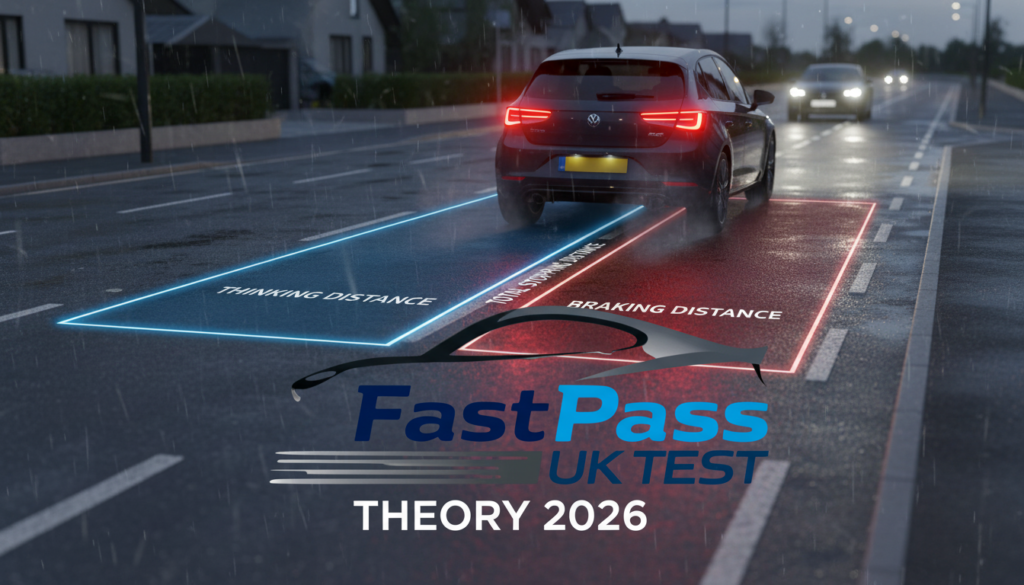
Stopping distance is the total distance your vehicle travels from the moment you notice a hazard until the car comes to a complete stop.
It is made up of two key parts:
- Thinking distance
- Braking distance
👉 Formula (basic concept):
Stopping Distance = Thinking Distance + Braking Distance
This is one of the most common questions in the UK theory test.
2. Full Stopping Distance Formula (Theory Test Method)
Here is the simplified formula used in many theory test calculations:
Stopping Distance=x220+x\text{Stopping Distance} = \frac{x^2}{20} + xStopping Distance=20x2+x
Where:
- x = speed in mph
- Result = stopping distance (in feet)
👉 Example:
If speed = 30 mph
= (30 × 30 ÷ 20) + 30
= 900 ÷ 20 + 30
= 45 + 30
= 75 feet
3. Real Stopping Distance Examples (DVSA-Based)
Here are typical stopping distances you should remember:
| Speed | Total Stopping Distance |
|---|---|
| 20 mph | 12 metres |
| 30 mph | 23 metres |
| 40 mph | 36 metres |
| 50 mph | 53 metres |
| 60 mph | 73 metres |
| 70 mph | 96 metres |
These values are based on official Highway Code estimates used in theory tests.
👉 Example:
At 50 mph:
- Thinking distance = 15 metres
- Braking distance = 38 metres
- Total = 53 metres
4. Understanding Thinking Distance
Thinking distance is the distance you travel while reacting to a hazard.
This includes:
- Seeing the danger
- Deciding to act
- Moving your foot to the brake
👉 Important:
Reaction time is usually assumed to be around 0.7 seconds, but it can increase due to fatigue or distraction.
Factors That Increase Thinking Distance:
- Tiredness
- Mobile phone use
- Alcohol or drugs
- Poor concentration
5. Understanding Braking Distance
Braking distance is the distance your car travels after you press the brakes until it stops completely.
👉 Key fact:
Braking distance increases with the square of speed, meaning higher speeds drastically increase stopping distance.
Factors That Affect Braking Distance:
- Road conditions (wet, icy, dry)
- Tyre condition
- Brake quality
- Vehicle load
- Driving downhill
👉 Example:
Doubling your speed can more than double your braking distance.
6. Easy Trick to Remember Stopping Distances
Here’s a simple memory trick used by many learners:
- Thinking distance increases by 3 metres per 10 mph
- Braking distance increases rapidly with speed
Another trick (in feet):
- Speed = thinking distance
- Multiply speed by increasing numbers (2, 2.5, 3, etc.) for total
These tricks help you answer questions quickly in the exam.
7. How Weather Affects Stopping Distance
Weather plays a huge role in stopping distances.
👉 Key rules for theory test:
- Wet roads = double stopping distance
- Icy roads = up to 10× longer
This is one of the most common theory test questions.
8. Why Stopping Distances Matter in Real Driving
Stopping distances are not just for exams—they are critical for safety.
They help you:
- Maintain safe distance from other vehicles
- Avoid collisions
- Adjust speed in dangerous conditions
👉 Important rule:
Always drive at a speed that allows you to stop within the distance you can see to be clear.
9. Common Theory Test Questions (2026)
In the 2026 test, you may be asked:
- What is stopping distance at a certain speed?
- How does weather affect stopping distance?
- What increases thinking distance?
- Which factor affects braking distance most?
👉 Tip:
Focus more on understanding concepts rather than memorizing numbers.
10. DVSA Tips to Remember for Exam
Follow these expert tips to score easy marks:
✔ Learn the formula and basic values
✔ Practice real-life examples
✔ Understand reaction and braking differences
✔ Revise weather-related rules
✔ Take mock tests regularly
11. Final Thoughts
Mastering stopping distances theory test 2026 is one of the easiest ways to secure marks in your exam. Once you understand the formula and real-world application, this topic becomes simple and predictable.
Remember, stopping distances are not just numbers—they represent your ability to stay safe on the road. With consistent practice and the right strategy, you can confidently answer any question related to this topic.