
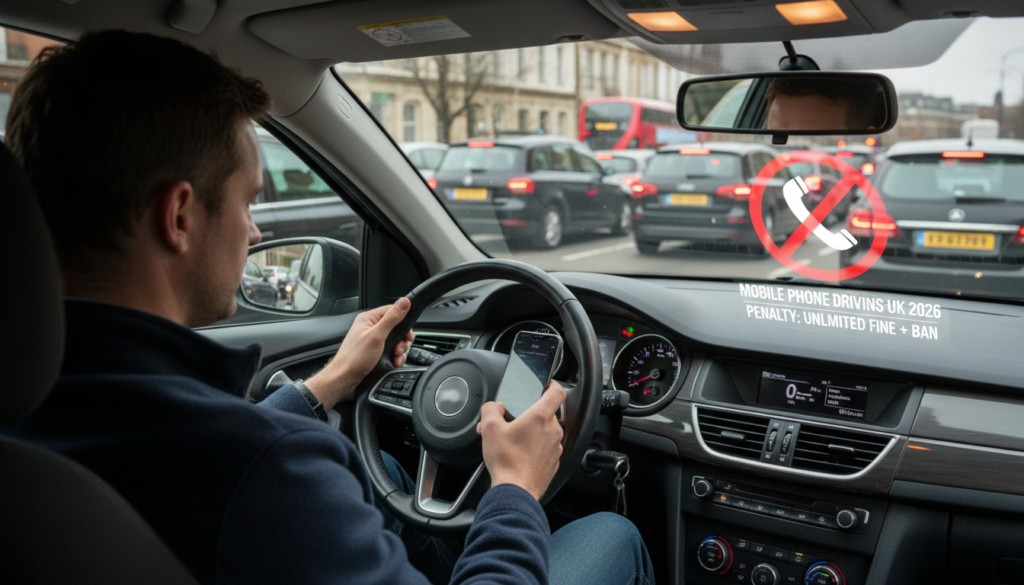
Mobile Phone Driving Laws UK 2026 – Strict Rules, Fines & Penalties Explained
Understanding mobile phone driving laws UK 2026 is essential for passing your UK driving theory test and staying safe on the road. Using a mobile phone while driving is one of the leading causes of accidents, and UK law has become stricter to reduce these risks.
In 2026, the rules clearly state that drivers must not use handheld devices while driving under any circumstances, except in specific emergency situations.
1. What Does the Law Say in 2026?
The mobile phone driving laws UK 2026 prohibit using a handheld mobile phone while driving.
This includes:
- Making or receiving calls
- Sending or reading messages
- Using apps or browsing the internet
- Taking photos or videos
- Checking notifications
Even holding your phone at a traffic light or in slow-moving traffic is illegal.
2. What Counts as “Using a Phone”?
In the illegal phone use while driving UK, the law defines “use” very broadly.
You are breaking the law if you:
- Touch your phone
- Unlock your phone
- Hold it for any reason
This applies even if your vehicle is stationary but the engine is running.
3. Penalties for Using a Mobile Phone While Driving
The using phone while driving UK fine 2026 is strict and enforced heavily.
✔ Standard Penalty:
- £200 fine
- 6 penalty points on your licence
✔ For New Drivers:
If you passed your driving test within the last 2 years:
- Your licence may be revoked immediately
✔ Serious Cases:
If the case goes to court:
- Higher fines
- Driving ban
- Increased insurance costs
Understanding these penalties is important for both real driving and the theory test.
4. Are Hands-Free Devices Legal?
According to UK driving laws mobile phone rules, hands-free use is allowed but with strict conditions.
You can use:
- Bluetooth headsets
- Voice commands
- Built-in car systems
However, you must not lose control of your vehicle. If your driving is affected, you can still be penalized.
5. When Is It Legal to Use a Phone?
There are limited exceptions under DVSA mobile phone driving rules:
✔ Emergency Situations
You can use your phone to call emergency services if:
- It is unsafe to stop
- You are reporting an emergency
✔ Parked Safely
You can use your phone if:
- Your vehicle is fully parked
- Engine is off
✔ Contactless Payments
You can use your phone for payments (e.g., drive-thru), but only when stationary.
6. Why These Laws Are So Strict
Mobile phone use while driving increases the risk of accidents significantly.
Risks include:
- Slower reaction time
- Reduced awareness
- Poor decision-making
The mobile phone driving laws UK 2026 aim to reduce these risks and improve road safety.
7. Common Mistakes Learners Make
Many learners misunderstand the law and make avoidable mistakes:
- Thinking it’s okay to check notifications briefly
- Using the phone at traffic lights
- Holding the phone without using it
- Relying too much on hands-free systems
These mistakes can lead to failure in both the theory test and real driving.
8. DVSA-Based Tips to Pass
Follow these proven strategies:
✔ Remember “Hands-Free Only” Rule
Never touch your phone while driving.
✔ Understand Legal Exceptions
Know when phone use is allowed.
✔ Practice Theory Questions
Practice UK theory test questions here
Learn hazard perception clips here
✔ Focus on Safety
Think like a responsible driver.
9. External Resources (IMPORTANT)
Official UK Government mobile phone driving laws
Highway Code rules on mobile phone use
10. How This Appears in the Theory Test
In the mobile phone driving laws UK 2026 section of the theory test, you may get questions like:
- When can you legally use a mobile phone?
- What is the penalty for using a phone while driving?
- Is hands-free use always safe?
Understanding these questions will help you score higher.
11. Final Thoughts
The mobile phone driving laws UK 2026 are designed to protect all road users. Using a mobile phone while driving is not just illegal — it is dangerous.
By understanding the rules, avoiding common mistakes, and practicing regularly, you can pass your theory test and become a safer driver.